Semaglutide is a GLP-1 receptor agonist medication used to treat type 2 diabetes and, in higher doses, obesity. In Singapore, it's available as a once-daily oral tablet (Rybelsus). Weekly injectable forms (Ozempic, Wegovy) are approved in principle but not yet available through official channels due to ongoing global supply constraints.
Semaglutide is manufactured by Novo Nordisk (Denmark) in both its oral and injectable forms. Interest peaked in 2022-2024 when high-profile individuals such as Elon Musk and Oprah Winfrey posted on their social media accounts that they were taking this medication for weight management, leading to surging global demand and widespread supply shortages that continue to affect Singapore.
Is Ozempic the Same as Semaglutide in Singapore?
Ozempic is the brand name Novo Nordisk uses for injectable semaglutide, prescribed for type 2 diabetes; Wegovy is the brand name for the same active ingredient at a higher, weight-management dose. When people search "Ozempic Singapore," they're usually asking about the injectable form of the same medication discussed throughout this page under its generic name, semaglutide.
As explained further below, Ozempic Singapore availability through official channels remains pending as of this page's most recent medical review, while oral semaglutide (Rybelsus) is available now at Bay Aesthetics Clinic. Patients often research "Ozempic Singapore" and "Rybelsus Singapore" side by side because both deliver the same active ingredient, just in different formulations and doses.
GLP-1 receptors are present throughout the body, GLP-1 receptor medications such as semaglutide act on multiple organ systems
How Does semgaglutide work?
Semaglutide is a medication that mimics a natural hormone in the body called GLP-1 (glucagon-like peptide-1). GLP-1 is involved in regulating blood sugar levels and controlling appetite. Semaglutide works in several ways:
Increases insulin secretion: When blood sugar levels rise, semaglutide helps stimulate the pancreas to release insulin, a hormone that lowers blood sugar.
Decreases glucagon secretion: Glucagon is another hormone that raises blood sugar by signalling the liver to release stored glucose. Semaglutide reduces glucagon levels, which helps prevent the liver from releasing too much glucose.
Slows gastric emptying: Semaglutide slows down the process of stomach emptying, which helps you feel fuller for longer, reduces overall food intake, and helps with weight loss.
Appetite suppression: It also acts on the brain to reduce appetite, leading to a decrease in food intake, which can contribute to weight loss. Semaglutide is used in the treatment of type 2 diabetes (to help manage blood sugar levels) and obesity (to support weight loss). Both oral semaglutide and injectable semaglutide are options.
Oral semaglutide vs Injectable Semaglutide
Both types of semaglutide contain the same medication- semaglutide, and are manufactured by the same pharmaceutical company- Novo Nordisk (Denmark). Recently, they been the subject of significant media attention, with celebrities such as Elon Musk and Oprah Winfrey sharing on social media their weight loss transformation after using these medications. As a result, there is a global shortage, with patients now resorting to off label usage of oral semaglutide for weight management
Disclaimer: Oral Semaglutide is licenced in Singapore for the treatment of diabetes. Use of Oral Semaglutide in non diabetic patients is considered off label.
Can I switch between oral and injectable semaglutide?
Can I switch between oral and injectable semaglutide? (ozempic singapore vs. Rybelsus Singapore)
Oral semaglutide 14mg is approximately equivalent to a 0.5mg weekly injection. This conversion is commonly used when patients who obtained an injectable prescription (locally or overseas) run out of supply and need to switch to oral semaglutide, or to daily liraglutide (Saxenda).
Injectable semaglutide supplies in Singapore are also inconsistent, with frequent supply shortages. In times of shortage, injectable semaglutide stocks are diverted to government hospitals, with the treatment of subsidised patients with poorly controlled diabetes given priority. Hence, it is common for patients who were previously on injectable semaglutide to need to switch to oral semaglutide or daily liraglutide injections.
Any switch between forms should be supervised by a doctor.
Results and outcomes of Semaglutide
Semaglutidehas been extensively studied, with multiple clinical studies proving that it is safe and effective in the treatment of type 2 diabetes, obesity, chronic kidney disease and cardiovascular disease
Summary of the effects of Semaglutide
Type 2 Diabetes
Lowers HbA1c (key indicator for diabetic control) by 1.0–2.0%
Helps maintain steady blood sugar levels and reduces spikes after meals.
Obesity
Significant weight loss (5–15% of body weight).
Cardiovascular Benefits
Significant 26% reduction in major cardiovascular events (heart attack, stroke, or heart-related death).
Lower blood pressure and cholesterol levels.
Clinical studies for Semaglutide
Semaglutide, a GLP-1 receptor agonist, has been shown in multiple clinical trials to be effective for the treatment of type 2 diabetes. Several landmark clinical trials have been conducted to measure semaglutide effectiveness in reducing HbA1c (a key marker for diabetic control), as well as its effects on obesity and cardiovascular risk. These are the SUSTAIN and STEP trials.
Semaglutide and diabetes: SUSTAIN 1-7 clinical trials
TLDR summary of SUSTAIN trials: Diabetic and overweight patients controlled their diabetes and lost weight when treated with injectable semaglutide, even more so as compared to standard diabetic medication.
Full Statitics
In the SUSTAIN 1-7 series of clinical trials which investigated the effectiveness of once weekly semaglutide injections for the treatment of diabetic and obese patients, semaglutide consistently demonstrated significant reductions in HbA1c levels compared to placebo and other usual diabetes medications (metformin, sitagliptin, dulaglutide). In addition, diabetic patients treated over a 30-56 week period experienced 4.5-6.5kg weight loss.
SUSTAIN 1-7 series of clinical trials compared the results of treating diabetic patients with once-weekly semaglutide injections with placebo or standard diabetes medicationSummary of Hba1c and weight loss outcomes from the SUSTAIN 1-7 trials
Semaglutide and obesity: STEP1 clinical trial
TLDR summary of STEP 1 trial: Patients treated with high dose once weekly semaglutide 2.4mg injections lost a significant amount of weight over a 68-week period
Full Statitics
The STEP 1 clinical trial, published in the New England Journal of Medicine in 2021, involved 1961 adult patients with obesity (BMI >30) or overweight (BMI >27 with 1 obesity-related comorbidity). The patients were randomised into the treatment arm with once-weekly semaglutide 2.4mg versus placebo. After 68 weeks, the patient group treated with once-weekly semaglutide 2.4mg experienced significant weight loss of 14.9% body weight reduction versus 2.4% placebo group. The average amount of weight loss in the treatment group was 15.3kg, as compared to 2.6kg in the placebo group. Most of the patients treated with semaglutide lost a significant amount of weight: 32% of patients lost over 20% body weight, 50.5% of patients lost over 15% body weight loss, 69.1% achieved 10% body weight loss and 86.4% achieved 5% body weight loss. Nausea and diarrhoea were the most common side effects which were transient and improved with time, with less than 5%
The results of the STEP 1 trial which looked at once-weekly semaglutide for the treatment of obesity published in the New England Journal of MedicineSTEP 1 study for once weekly high dose semaglutide 2.4mg - demographic and clinical parameters of the treatment versus the placebo groupResults of the 68-week STEP 1 trial with once-weekly semaglutide 2.4mg showing the percentage of patients who lost 5%, 10%, 15% and 20% body weight as compared to placebo
Semaglutide and Cardiovascular risk: SUSTAIN 6 trial
TLDR summary: The SUSTAIN 6 trial looked at the cardiovascular outcomes (cardiovascular death, heart attack and stroke) in high cardiovascular risk diabetic patients being treated with semaglutide versus placebo- with the results showing a significant 26% reduction in cardiovascular death, heart attack and stroke in patients being treated with semaglutide
Full Statitics
The SUSTAIN 6 trial published in the New England Journal of Medicine showed that in patients with type 2 diabetes who were at high cardiovascular risk.
Rate of cardiovascular death, nonfatal myocardial infarction (heart attack), or nonfatal stroke was significantly lower among patients receiving semaglutide than among those receiving placebo. 3297 patients with type 2 diabetes were treated with once-weekly semaglutide injections (0.5 mg or 1.0 mg Ozempic) or placebo for 104 weeks. The primary outcome was cardiovascular death, nonfatal myocardial infarction, or nonfatal stroke. At baseline, 2735 of the patients (83.0%) had established cardiovascular disease, chronic kidney disease, or both. The primary outcome occurred in 108 of 1648 patients (6.6%) in the semaglutide treatment group and in 146 of 1649 patients (8.9%) in the placebo group- representing a 26% reduction in risk.
The SUSTAIN 6 trial looked at the cardiovascular outcomes (cardiovascular death, heart attack and stroke) in high cardiovascular risk diabetic patients being treated with semaglutide versus placebo- with the results showing a significant reduction in cardiovascular death, heart attack and stroke in patients being treated with semaglutide
Oral Semaglutide: PIONEER 4 & 6 clinical trial
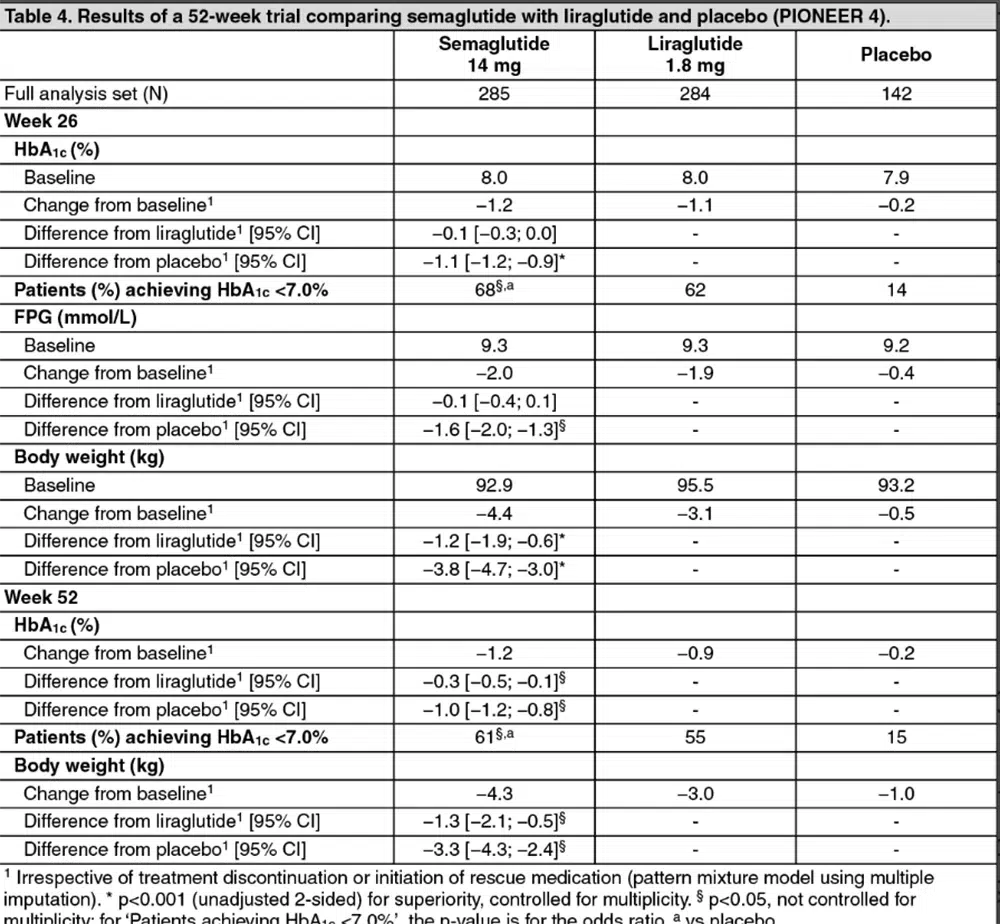
TLDR summary of PIONEER 4 & 6 trials: The oral semaglutide 14mg group achieved a 1.2% reduction in HbA1c and 4.3kg of weight loss, outperforming the liraglutide group. By the end of the PIONEER 6 trial, 35% of patients diabetes and obesity who were treated with semaglutide had lost more than 5% of their body weight, and 15% had lost more than 10%.
Full Statitics
In the PIONEER 4 trial, 711 patients with diabetes were randomised to oral semaglutide 14mg, liraglutide 1.mg and placebo. After 52 weeks of treatment, the patients in the oral semaglutide 14mg treatment group achieved a 1.2% reduction in Hba1c and 4.3kg weight loss. The results were more significant in the Oral Semaglutide group compared to the Liraglutide group.
In another double blind trial (PIONEER 6) which focused on cardiovascular outcomes, 3,183 patients with diabetes and obesity (mean BMI 32.3) were treated for 16 months. By end of treatment, 35% of patients had loss >5% of body weight, and 15% of patients had lost 10% of body weight in the Semaglutide group.
Other benefits of semaglutide
The effects of semaglutideon diabetes, hypertension, hyperlipidemia and obesity are well established- there are several emerging benefits of semaglutide that are an area of active research.
Fertility
In recent years there have been a large number of case reports of women who were thought to be infertile becoming pregnant after being treated with semaglutide. The link between Semaglutide and Fertility is still a topic of active research and is thought to be due to improved hormonal regulation that comes with weight loss. Semaglutide is not used as a fertility treatment and is not recommended for pregnant or breastfeeding women.
Alcohol use disorder and smoking
In a randomised clinical trial with 48 participants, low-dose semaglutide reduced the amount of alcohol consumed by patients with alcohol use disorder, and reduced cravings for alcohol and cigarettes, over 9 weeks. Another clinical study found reduced rates of alcohol use-related hospitalisations amongst patients being treated with Semaglutide.
Fatty Liver (Non-Alcoholic Fatty Liver Disease)
Currently, Semaglutide is undergoing clinical trials to investigate its effectiveness in treating Non-Alcoholic Fatty Liver Disease which is also known as Metabolic Dysfunction associated steatotic liver disease, with US FDA approval pending. The mechanism of action of Semaglutide in treating fatty liver is thought to be indirect, through weight loss, although metabolic changes at the level of the mitochondria have been proposed.
Side effects and risks of semaglutide
Semaglutide has been in clinical use for over 20 years with its side effect profile well studied in clinical trials- Side effects from Semaglutide are generally mild and subside with time, with most symptoms improving after the initial 1-2 months.
Common side effects include:
Gastrointestinal side effects:
Nausea, vomiting, diarrhea, constipation
Neurological side effects:
Headache, dizziness
Face:
Sagging skin and sunken hollow faces from weight loss
Rare but potentially significant side effects include:
Due to a global supply shortage of medication, it is common for patients to need to convert between the different formulations of semaglutide. Injectable semaglutide has been approved in Singapore but stocks have not yet arrived (estimated to become available in 2026), so patients started on injectable semaglutide by their doctors overseas will have to convert to substitute when they are in Singapore. Most injectable semaglutide contain the same key ingredient semaglutide and may be used interchangeably.
Injectable semaglutide supplies in Singapore are also inconsistent, with frequent supply shortages. In times of shortage, injectable semaglutide stocks are diverted to government hospitals, with the treatment of subsidised patients with poorly controlled diabetes given priority. Hence, it is common for patients who were previously on injectable semaglutide to need to switch tooral semaglutideor daily liraglutide injections.
Conversion table of oral and injectable semaglutide
Buying Semaglutide in Singapore
Semaglutide are prescription medications that are only available at licenced medical clinics and hospitals. A doctor's consultation is required to determine medical suitability before the medication can be prescribed. Do not purchase these prescription medications from dubious online sources or from overseas. Due to the popularity of the medications, counterfeit and tainted products are common and patients need to ensure they obtain authentic medications from a reputable source. Patients looking for a doctor-supervised weight management programme can also learn more about Bay Medical's comprehensive semaglutide treatment, where suitability is assessed as part of an individualised medical weight management plan. Do not accept the medication if it has been opened or the seal is broken.
Weekly injectable semaglutide is not yet available in Singapore via official channels- any person or clinic who claims to have a supply of weekly injectable semaglutide is definitely not being completely honest. Weekly injectable semaglutideis expected to be available in Singapore in 2026, and the prices of are not fixed yet. Patients who were taking weekly injectable semaglutide from overseas clinics need to switch to an alternative avaible in Singapore.
Alternatives which are available in Singapore although supply may be an issue. The price ranges from $500-800 per box (4x1mg dosage).
Oral semaglutide is available in Singapore, price ranges from $400-600 per box (3,7 and 14mg dosage).
Ozempic Where to Buy in Singapore: What You Need to Know
A large number of people searching "Ozempic where to buy" in Singapore are looking for a straight answer: as of this page's most recent medical review, weekly injectable Ozempic is not yet available through official channels here, and any seller or clinic claiming otherwise should be treated with real caution. This isn't a marketing restriction — it reflects a genuine, ongoing local supply and registration gap, even though global manufacturing shortages for Ozempic and Wegovy eased in 2025.
Patients asking where to buy Ozempic in Singapore today are usually better served by oral semaglutide (Rybelsus), available now at Bay Aesthetics Clinic with a doctor's consultation, delivering the same active ingredient at an equivalent dose (14mg oral is roughly equivalent to a 0.5mg weekly injection, as noted above). This is why the pricing table below lists Ozempic Singapore as "pending official availability" rather than quoting a firm retail price.
Once weekly Semaglutide injection comes in 0.25mg, 0.5mg and 1mg per week doseOnce weekly semaglutide injection comes in 0.25mg, 0.5mg, 1mg, 1.7mg and 2.4mg per week dose. Contain the same active ingredient semaglutide in different dosagesOnce daily oral semaglutide comes in 3mg, 7mg and 14mg dosages
How to start using semaglutide?
Semaglutide Injection
To minimise side effects and allow the body to acclimatise to the medication, it is recommended to start semaglutide at a low dose of 0.25mg or 0.5mg per week for 1 month, before increasing to a medium dose of 1mg per week. Thereafter, depending on the effects of the medication and clinical requirements, the dosage may need to be increased to the maximum dose of 2mg or 2.4mg per week.
Dosage schedule. Starting with low doses of 0.25mg and 0.5mg and slowly increasing to a maximum dose of 2.4mgDosage schedule. Starting with a low dose of 0.25mg or 0.5mg, with a gradual increase to a maximum dose of 1mg.
Oral Semaglutide
Oral Semaglutide is a tablet taken once daily in the morning with small sips of water. After taking the medication, it is recommended not to eat, drink or consume other medications for 30 minutes.
Oral Semaglutide comes in 3mg, 7mg and 14mg dosages. Most patients start at a 3mg dose for a month, before increasing to a 7mg dose. Where required, a 14mg dose may be prescribed.
If a dose is missed, the medication should be skipped for a day and the next dose taken the following day. Do not double-dose by taking the medication at night and again in the morning the next day.
Semaglutide price in Singapore
Form
Dosage
Indicative price
Status in Singapore
Oral tablet (Rybelsus Singapore)
3mg, 7mg, 14mg
$400 ~ 600 per box
Available now
Weekly injection (Ozempic Singapore)
0.25mg–1mg/week
$250 ~ $700
Pending official availability
Where to get semaglutide in Singapore
Semaglutide is a prescription medication that is only available at licensed medical clinics and hospitals. A doctor's consultation is required to determine medical suitability before the medication can be prescribed. Do not purchase these prescription medications from dubious online sources or from overseas. Due to the popularity of the medications, counterfeit and tainted products are common, and patients need to ensure they obtain authentic medications from a reputable source. Do not accept the medication if it has been opened or the seal is broken.
Weekly injectable semaglutide (ozempic) is not yet available in Singapore via official channels- any person or clinic that claims to have a supply of weekly injectable semaglutide is definitely not being completely honest. Weekly injectable semaglutide is expected to be available in Singapore in 2026, and the prices are not fixed yet. Patients who were taking weekly injectable semaglutide from overseas clinics need to switch to an alternative available in Singapore.
How to Avoid Counterfeit Ozempic Singapore Sellers
Because Ozempic Singapore searches are so high in volume, they've also attracted counterfeit sellers and unlicensed listings claiming to offer stock that officially isn't here yet. Warning signs include sellers based overseas shipping into Singapore, prices that seem unusually low for an internationally sought-after medication, and any offer made without requiring a doctor's consultation or prescription.
The safest way to confirm genuine Ozempic Singapore availability is to ask a licensed clinic directly, rather than relying on social media listings or classifieds. Bay Aesthetics Clinic can advise on the current status of injectable semaglutide supply and discuss oral semaglutide as an available alternative in the meantime.
Conclusion
Semaglutideis safe and effective for the treatment of diabetes, and obesity and reduces adverse cardiovascular outcomes. Further research is required to investigate the effect of semaglutide treatment on fatty liver, alcohol use disorder and fertility.
Meet Dr Hoe Ying Min, Medical Director at Bay Aesthetics Clinic
Dr Hoe Ying Min is the Medical Director of Bay Aesthetics Clinic and graduated from NUS with degrees in Medicine, Surgery, and Medical Science. Patients considering semaglutide-based medical weight management are assessed individually before treatment is recommended. The consultation allows relevant health factors, treatment suitability, and the wider weight-management plan to be discussed with a doctor.
Oral semaglutide (Rybelsus) costs roughly $[400–600] per box in Singapore. Weekly injectable semaglutide (Ozempic, Wegovy) does not yet have fixed Singapore pricing, as it isn't currently available through official channels.
Is semaglutide available in Singapore?
Not yet through official channels. Weekly injectable semaglutide (Ozempic) is approved in principle, but supply has not arrived in Singapore due to a global shortage. Any clinic or seller offering weekly injectable semaglutide currently should be treated with caution. Oral semaglutide (Rybelsus) is available now as an alternative.
What's the difference between the different types of semaglutide?
All three brands contain semaglutide as the active ingredient. Ozempic and Wegovy are weekly injections (Wegovy at a higher dose, specifically for weight management); Rybelsus is a once-daily oral tablet. They're not interchangeable without medical guidance on dose conversion.
Can I switch from injectable to oral semaglutide?
Yes, under medical supervision. Oral semaglutide 14mg is approximately equivalent to a 0.5mg weekly injection. This is a common switch for patients who run out of injectable supply due to the ongoing global shortage.
Is oral semaglutide safe for weight loss if I don't have diabetes?
Oral semaglutide is licensed in Singapore for type 2 diabetes; using it for weight management without diabetes is considered off-label. This should only be done under medical guidance, following a consultation to assess suitability.
Can I buy semaglutide online in Singapore?
No. Semaglutide, in any form, is prescription-only in Singapore and requires a doctor's consultation. Buying from unauthorised online sources risks counterfeit or unsafe products.
How much weight can I lose with semaglutide?
In the STEP 1 clinical trial, patients on once-weekly 2.4mg injectable semaglutide lost an average of 14.9% of body weight over 68 weeks, compared with 2.4% in the placebo group. In the oral PIONEER 4 trial, the 14mg group lost an average of 4.3kg over 52 weeks.
What's the difference between semaglutide and Tirzepatide?
Semaglutide (Ozempic) targets one receptor pathway (GLP-1), while Tirzepatide (Mounjaro) targets two (GIP and GLP-1). In head-to-head trial data, Tirzepatide was associated with greater average weight loss, though individual response varies. Read the full Tirzepatide guide →
What are the side effects of semaglutide?
The most common side effects are gastrointestinal (nausea, vomiting, diarrhoea, constipation) and usually improve within 3–4 weeks. Rarer but more serious risks include acute pancreatitis and gallstone formation. Read the full side effects guide →
How long does semaglutide treatment typically last?
Semaglutide is generally used as a long-term treatment for weight management, since weight regain is common after stopping. Duration should be individualised with your doctor based on your response and goals.
Where can I buy Ozempic in Singapore right now?
As of this page's most recent medical review, Ozempic Singapore stock through official channels is still pending, due to a separate local supply and registration gap even though global manufacturing shortages eased in 2025. Oral semaglutide (Rybelsus) is available now at Bay Aesthetics Clinic as an alternative delivering the same active ingredient.
Is it safe to buy Ozempic Singapore listings I've seen online?
No. Since genuine Ozempic Singapore stock through official channels is still pending, any online listing offering immediate supply is a red flag for counterfeit or diverted product. Only obtain semaglutide, in any form, through a licensed clinic following a doctor's consultation.
With over 10 years of experience in aesthetic treatments, Dr Hoe Ying Min serves as the Medical Director at Bay Aesthetics Clinic. She has extensive hands-on experience in lasers, injectables, body-shaping and skin-rejuvenation procedures, and is known for her careful, personalised approach that aims for natural-looking outcomes.
Bay Aesthetics Clinic and Medical Spa is a doctor-led clinic located in the Marina Bay Financial Centre that delivers medical aesthetics and medispa treatments in a calm, professional setting. With a focus on safety, visible results and accessibility, the team uses only US FDA and approved technology, applies a holistic view to beauty and wellness, and avoids hard-selling or pressure tactics.
Open from 11 am daily (until 8 pm Mon-Fri; 6 pm Sat/Sun) and conveniently situated within walking distance of two MRT stations
Helpful Links
Contact Us
B2-12 Marina Bay Link Mall, 8A Marina Boulevard, Marina Bay Financial Center, Singapore 018984